I'm a participant in the Amazon Services LLC Associates Program, an affiliate advertising program designed to provide a means for me to earn fees by linking to Amazon.com and affiliated sites.
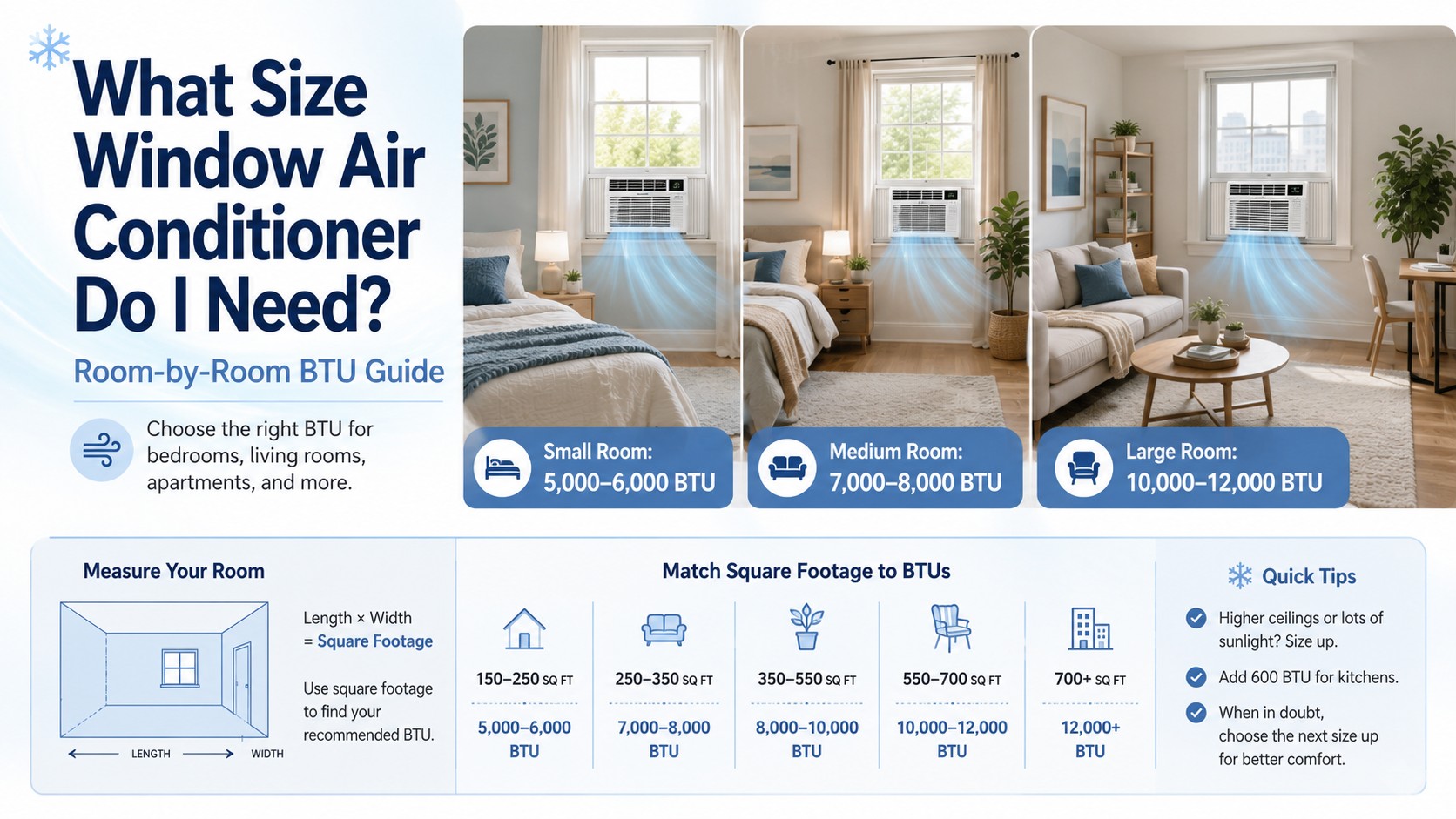
To choose the right size window air conditioner, multiply your room’s length by its width to get square footage, then match that square footage to the correct BTU range. For most rooms, you need about 20 BTUs per square foot, but you should adjust for sun, shade, kitchens, ceiling height, insulation, and how many people regularly use the room. The Department of Energy says room air conditioners generally range from about 5,500 to 14,000 BTUs per hour and that oversized units can cool too quickly without removing enough humidity.
For most homes, the simple answer looks like this:
Room Size | Common Room Type | Recommended Window AC Size |
|---|---|---|
100 to 150 sq. ft. | Small bedroom, small office | 5,000 BTU |
150 to 250 sq. ft. | Standard bedroom, nursery, office | 6,000 BTU |
250 to 300 sq. ft. | Large bedroom, small den | 7,000 BTU |
300 to 350 sq. ft. | Large bedroom, small living room | 8,000 BTU |
350 to 400 sq. ft. | Medium living room | 9,000 BTU |
400 to 450 sq. ft. | Large living room | 10,000 BTU |
450 to 550 sq. ft. | Open living space, large room | 12,000 BTU |
550 to 700 sq. ft. | Large open room or studio | 14,000 BTU |
This base chart follows ENERGY STAR’s room air conditioner sizing guidance for rooms with standard 8-foot ceilings. ENERGY STAR also recommends reducing capacity by 10% for heavily shaded rooms, increasing it by 10% for very sunny rooms, adding 600 BTUs for each extra person beyond two, and adding 4,000 BTUs if the unit is used in a kitchen.
Feature | |||
|---|---|---|---|
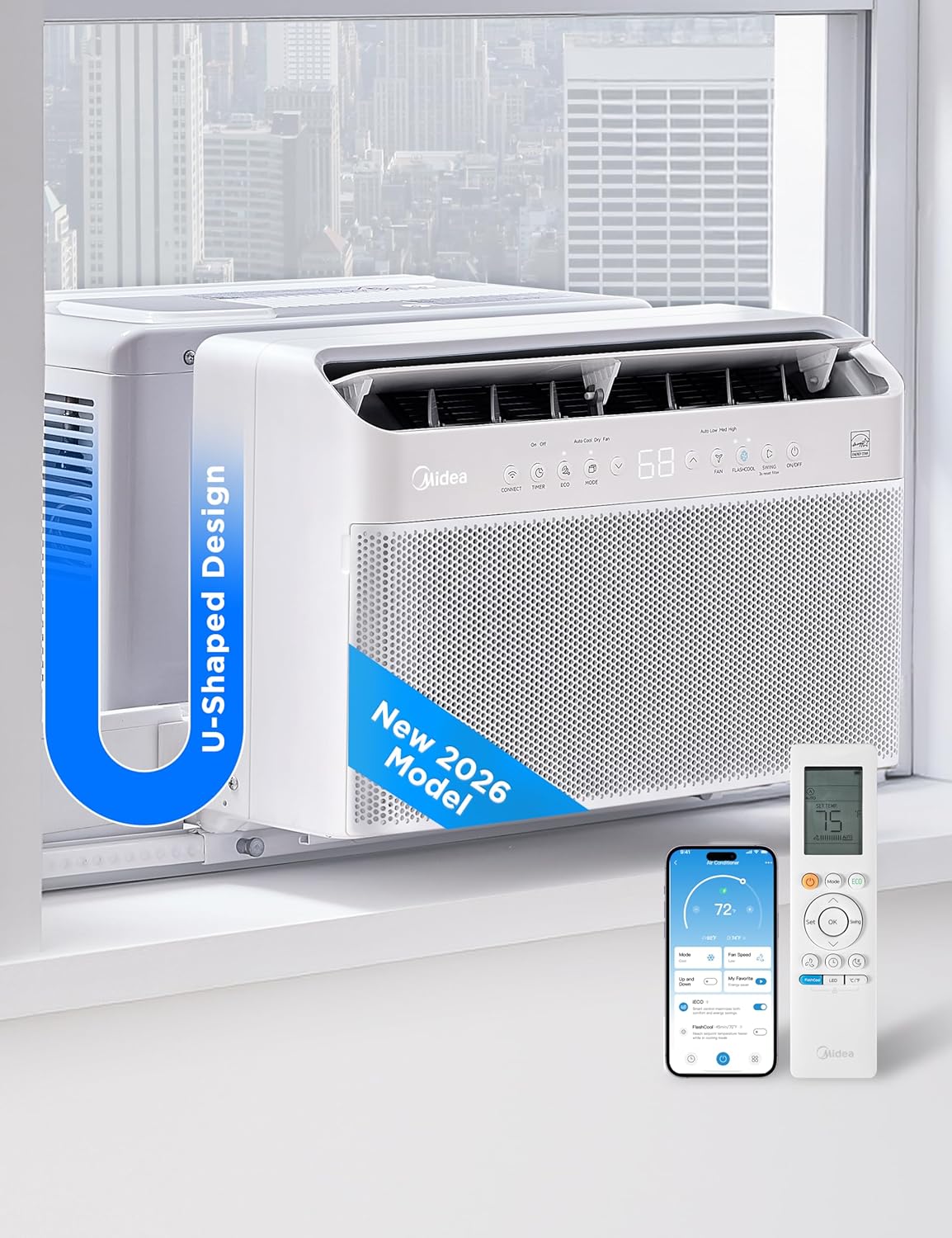 | 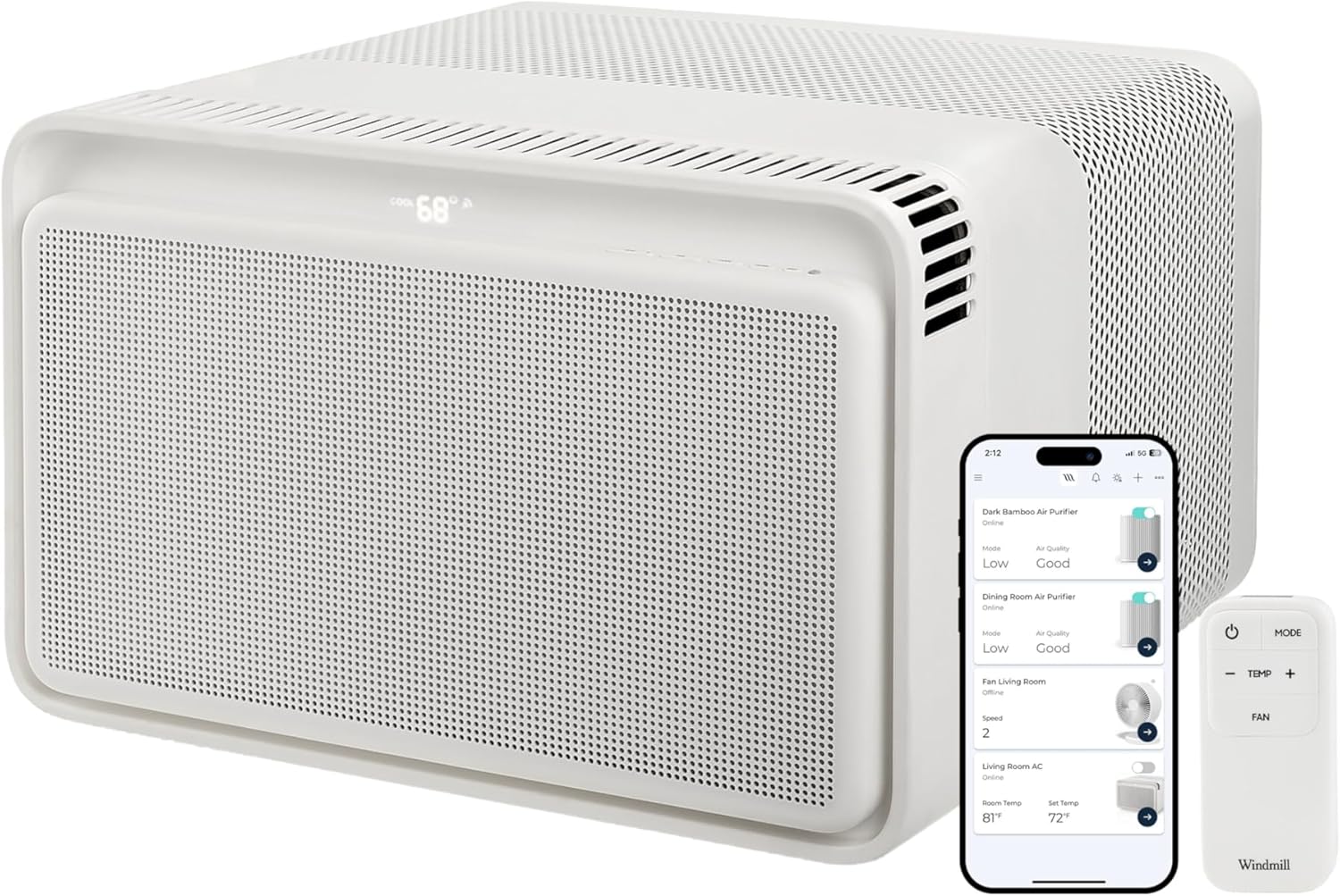 | 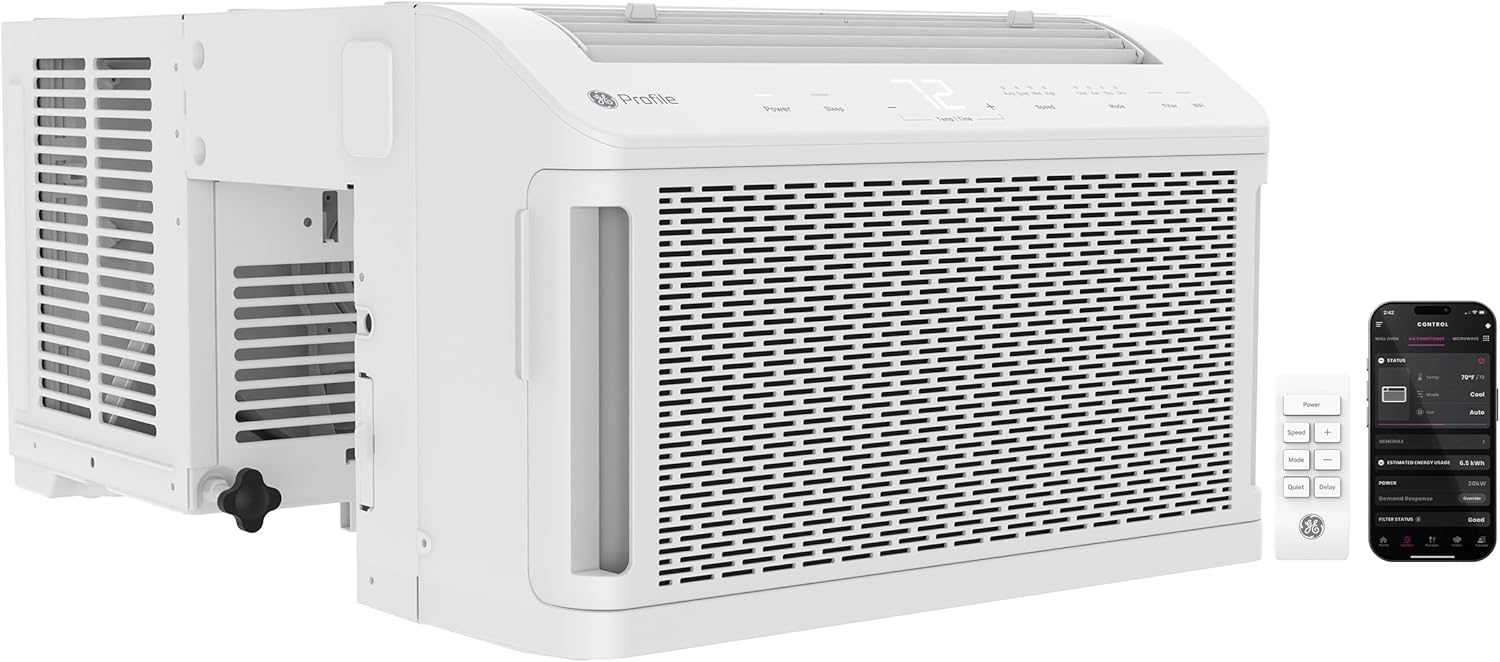 | |
Best For | Quiet cooling and strong value | Style, simple install, modern apartments | Premium window view and everyday comfort |
Common Size Compared | 8,000 BTU | 8,000 BTU | 8,300 BTU |
Listed Room Coverage | Up to 350 sq. ft. | Up to 350 sq. ft. | Up to 350 sq. ft. |
Design Type | U-shaped window AC | Modern front-panel window AC | Saddle / clear-view style window AC |
Lowest Listed Noise | As low as 32 dBA | Starts at 42 dB | Ultra quiet operation at 41 dB |
Smart Controls | App, Apple Watch, voice assistant | App, voice, remote | SmartHQ app, Alexa, Google Assistant, IFTTT, Nest, Sonos, Fresco |
Window View | Better than traditional AC | Traditional window blockage | Best window view of the three |
Installation Style | More involved U-shaped install | Pre-assembled kit, easier setup | Flex-depth design, more unique install |
Airflow Direction | Standard AC airflow through front | 45-degree upward airflow | Low-profile saddle-style airflow |
Filtration | Washable filter | Mesh plus activated carbon filter | Washable filter |
Energy Efficiency Angle | Variable-speed inverter, up to 45% more efficient claim | Up to 15.0 CEER, double-insulated side panels | Inverter-style premium efficiency positioning |
Biggest Strength | Quiet performance for the money | Looks and usability | Window view and premium comfort |
Biggest Concern | 2025 recall affected many U and U+ models | Higher price than basic ACs | Price and heavier installation |
Price |  | | |
Why Window AC Size Matters More Than Most People Think
A window air conditioner is one of those appliances where bigger sounds better.
It usually is not.
If the window AC is too small, it may run constantly and still never get the room comfortable. If it is too large, it may cool the room fast but shut off before it removes enough humidity. That can leave the room cold, damp, and clammy instead of comfortable. ENERGY STAR and the Department of Energy both warn that oversized room AC units waste energy and can do a poor job with humidity removal.
The goal is not to buy the biggest unit that fits your window.
The goal is to buy the unit that matches your room.
That means looking at:
- Room square footage
- Ceiling height
- Sun exposure
- Window size and direction
- Insulation
- Floor level
- Room use
- Number of people
- Whether the room is a kitchen
- Whether the room opens into another room
A 6,000 BTU window AC might be perfect for one bedroom and disappointing in another. A 10,000 BTU unit might be right for a sunny living room but too much for a shaded bedroom.
This guide walks through the sizing math in plain English.
Step 1: Measure the Room
Before comparing brands, features, or prices, measure the room.
For a square or rectangular room:
Length x width = square footage
Examples:
Room Dimensions | Square Footage |
|---|---|
10 ft. x 10 ft. | 100 sq. ft. |
10 ft. x 12 ft. | 120 sq. ft. |
12 ft. x 12 ft. | 144 sq. ft. |
12 ft. x 15 ft. | 180 sq. ft. |
14 ft. x 16 ft. | 224 sq. ft. |
15 ft. x 20 ft. | 300 sq. ft. |
20 ft. x 20 ft. | 400 sq. ft. |
20 ft. x 25 ft. | 500 sq. ft. |
For an L-shaped or irregular room, break the space into smaller rectangles, calculate each section, then add them together. ENERGY STAR recommends dividing complex rooms into squares, rectangles, and triangles to estimate total square footage.
Example:
- Main bedroom area: 12 ft. x 14 ft. = 168 sq. ft.
- Small dressing area: 5 ft. x 6 ft. = 30 sq. ft.
- Total: 198 sq. ft.
That room would usually need around a 6,000 BTU window AC before adjustments.
Feature | |||
|---|---|---|---|
| | | |
Best For | Quiet cooling and strong value | Style, simple install, modern apartments | Premium window view and everyday comfort |
Common Size Compared | 8,000 BTU | 8,000 BTU | 8,300 BTU |
Listed Room Coverage | Up to 350 sq. ft. | Up to 350 sq. ft. | Up to 350 sq. ft. |
Design Type | U-shaped window AC | Modern front-panel window AC | Saddle / clear-view style window AC |
Lowest Listed Noise | As low as 32 dBA | Starts at 42 dB | Ultra quiet operation at 41 dB |
Smart Controls | App, Apple Watch, voice assistant | App, voice, remote | SmartHQ app, Alexa, Google Assistant, IFTTT, Nest, Sonos, Fresco |
Window View | Better than traditional AC | Traditional window blockage | Best window view of the three |
Installation Style | More involved U-shaped install | Pre-assembled kit, easier setup | Flex-depth design, more unique install |
Airflow Direction | Standard AC airflow through front | 45-degree upward airflow | Low-profile saddle-style airflow |
Filtration | Washable filter | Mesh plus activated carbon filter | Washable filter |
Energy Efficiency Angle | Variable-speed inverter, up to 45% more efficient claim | Up to 15.0 CEER, double-insulated side panels | Inverter-style premium efficiency positioning |
Biggest Strength | Quiet performance for the money | Looks and usability | Window view and premium comfort |
Biggest Concern | 2025 recall affected many U and U+ models | Higher price than basic ACs | Price and heavier installation |
Price | | | |
Step 2: Match Square Footage to BTUs
BTU stands for British thermal unit. In air conditioners, BTU tells you how much heat the unit can remove from a room per hour.
Here is the practical window AC sizing chart.
Area to Cool | Recommended BTU |
|---|---|
100 to 150 sq. ft. | 5,000 BTU |
150 to 250 sq. ft. | 6,000 BTU |
250 to 300 sq. ft. | 7,000 BTU |
300 to 350 sq. ft. | 8,000 BTU |
350 to 400 sq. ft. | 9,000 BTU |
400 to 450 sq. ft. | 10,000 BTU |
450 to 550 sq. ft. | 12,000 BTU |
550 to 700 sq. ft. | 14,000 BTU |
700 to 1,000 sq. ft. | 18,000 BTU |
1,000 to 1,200 sq. ft. | 21,000 BTU |
1,200 to 1,400 sq. ft. | 23,000 BTU |
1,400 to 1,500 sq. ft. | 24,000 BTU |
1,500 to 2,000 sq. ft. | 30,000 BTU |
2,000 to 2,500 sq. ft. | 34,000 BTU |
For most bedroom, office, nursery, apartment, and living room situations, you will usually be shopping between 5,000 and 14,000 BTU. Consumer Reports groups many window units into small, medium, and large categories: small units around 5,000 to 6,500 BTU for roughly 100 to 250 square feet, medium units around 7,000 to 8,200 BTU for roughly 250 to 350 square feet, and large units around 9,800 to 12,500 BTU for roughly 350 to 550 square feet.
Step 3: Adjust for Sun, Shade, People, and Kitchens
The chart gives you the starting point.
Now adjust.
If the room is heavily shaded
Reduce capacity by about 10%.
Example:
A shaded 300-square-foot bedroom normally points to about 8,000 BTU. If the room stays shaded most of the day, a 7,000 BTU unit may be enough.
If the room gets strong sun
Increase capacity by about 10%.
Example:
A sunny 300-square-foot bedroom normally points to about 8,000 BTU. With strong afternoon sun, you may want closer to 9,000 BTU.
If more than two people regularly use the room
Add 600 BTUs for each additional person.
Example:
A 400-square-foot living room normally points to 10,000 BTU. If four people regularly use the room, add 1,200 BTU. That pushes the room closer to a 12,000 BTU unit.
If the unit is used in a kitchen
Add 4,000 BTUs.
Kitchens produce extra heat from ovens, stoves, dishwashers, refrigerators, sunlight, and people moving in and out. A kitchen needs more cooling capacity than a bedroom of the same size.
Example:
A 250-square-foot kitchen might start around 7,000 BTU. Add 4,000 BTU, and you are closer to 11,000 BTU, so a 10,000 to 12,000 BTU unit may make more sense.
These adjustments come from ENERGY STAR’s room AC sizing guidance.
Room-by-Room Window AC Sizing Guide
Small Bedroom
Room Example | Square Footage | Recommended Size |
|---|---|---|
10 ft. x 10 ft. | 100 sq. ft. | 5,000 BTU |
10 ft. x 12 ft. | 120 sq. ft. | 5,000 BTU |
11 ft. x 12 ft. | 132 sq. ft. | 5,000 BTU |
12 ft. x 12 ft. | 144 sq. ft. | 5,000 BTU |
A small bedroom usually does not need a huge window AC. A 5,000 BTU unit is often enough for a small sleeping space, especially if the room is shaded and has a standard ceiling.
Move up to 6,000 BTU if the room has afternoon sun, poor insulation, large windows, or a top-floor location.
Standard Bedroom
Room Example | Square Footage | Recommended Size |
|---|---|---|
12 ft. x 13 ft. | 156 sq. ft. | 6,000 BTU |
12 ft. x 15 ft. | 180 sq. ft. | 6,000 BTU |
13 ft. x 15 ft. | 195 sq. ft. | 6,000 BTU |
14 ft. x 16 ft. | 224 sq. ft. | 6,000 BTU |
For a normal bedroom, 6,000 BTU is often the sweet spot. It gives you more breathing room than a 5,000 BTU unit without jumping into a louder, heavier model.
Choose carefully if you are a light sleeper. A properly sized quieter unit is usually better than an oversized unit that cycles aggressively.
Large Bedroom or Primary Bedroom
Room Example | Square Footage | Recommended Size |
|---|---|---|
15 ft. x 17 ft. | 255 sq. ft. | 7,000 BTU |
16 ft. x 18 ft. | 288 sq. ft. | 7,000 BTU |
15 ft. x 20 ft. | 300 sq. ft. | 8,000 BTU |
18 ft. x 19 ft. | 342 sq. ft. | 8,000 BTU |
A large bedroom usually needs 7,000 to 8,000 BTU. If it has high ceilings, many windows, or intense sun, you may need to move up another size.
This is also where modern inverter window ACs can be especially helpful. ENERGY STAR notes that variable speed compressor technology can improve efficiency, cool more quietly, and control temperature more continuously than traditional on/off compressor designs.
Living Room
Room Example | Square Footage | Recommended Size |
|---|---|---|
18 ft. x 20 ft. | 360 sq. ft. | 9,000 BTU |
20 ft. x 20 ft. | 400 sq. ft. | 10,000 BTU |
20 ft. x 22 ft. | 440 sq. ft. | 10,000 BTU |
22 ft. x 24 ft. | 528 sq. ft. | 12,000 BTU |
Living rooms are trickier than bedrooms because they often connect to hallways, dining areas, kitchens, or entryways. If your living room is open to another room, calculate the total connected space, not just the spot where the AC sits.
A 400-square-foot living room may look like a 10,000 BTU room on paper. If it opens into a dining area, you may really be cooling 550 square feet or more.
Studio Apartment
Studio Size | Recommended Size |
|---|---|
300 sq. ft. | 8,000 BTU |
400 sq. ft. | 10,000 BTU |
500 sq. ft. | 12,000 BTU |
600 sq. ft. | 14,000 BTU |
Studio apartments are one of the easiest places to undersize a window AC.
The room may be “one room,” but it often includes sleeping, sitting, working, and kitchen space. If the kitchen is open to the studio, add extra capacity because cooking heat changes the cooling load.
For a studio apartment, choose based on the full usable space, not just the area near the window.
Kitchen
Kitchen Size | Base BTU | Adjusted Kitchen Size |
|---|---|---|
150 sq. ft. | 5,000 to 6,000 BTU | 9,000 to 10,000 BTU |
200 sq. ft. | 6,000 BTU | 10,000 BTU |
250 sq. ft. | 7,000 BTU | 11,000 to 12,000 BTU |
300 sq. ft. | 8,000 BTU | 12,000 BTU |
Kitchens need special treatment because they produce heat. ENERGY STAR recommends adding 4,000 BTUs if the air conditioner is used in a kitchen.
That means a kitchen often needs a much larger unit than a bedroom of the same square footage.
Quick BTU Examples
Example 1: 12 x 12 bedroom
12 x 12 = 144 sq. ft.
A 144-square-foot bedroom usually needs 5,000 BTU.
If the room is very sunny, move closer to 6,000 BTU.
Example 2: 14 x 16 bedroom
14 x 16 = 224 sq. ft.
A 224-square-foot bedroom usually needs 6,000 BTU.
If it is a top-floor bedroom with afternoon sun, consider 7,000 BTU.
Example 3: 15 x 20 living room
15 x 20 = 300 sq. ft.
A 300-square-foot room usually needs 8,000 BTU.
If it opens into a hallway or dining area, measure that connected space too.
Example 4: 20 x 20 living room
20 x 20 = 400 sq. ft.
A 400-square-foot room usually needs 10,000 BTU.
If it gets strong sun or regularly holds several people, consider 12,000 BTU.
Example 5: 500-square-foot studio
A 500-square-foot studio usually needs 12,000 BTU.
If the studio has a kitchen, poor insulation, or large sunny windows, consider 14,000 BTU.
Should You Size Up or Size Down?
When you are between two sizes, do not automatically size up.
Ask these questions first.
Size up if:
- The room gets strong afternoon sun
- The room is on the top floor
- The ceiling is higher than 8 feet
- The room has poor insulation
- The room has large windows
- The room opens into another space
- More than two people regularly use the room
- The room includes a kitchen
- You live in a very hot or humid climate
Stay at the lower size if:
- The room is heavily shaded
- The room has standard 8-foot ceilings
- The room is well insulated
- Doors stay closed
- The window seal will be tight
- The room is mainly used by one or two people
- You are cooling a bedroom for sleep
For bedrooms, the lower correct size is often better than oversizing. A smaller, properly sized unit that runs longer can remove humidity more effectively than an oversized unit that cools too quickly and shuts off.
What Happens If Your Window AC Is Too Small?
An undersized window AC may:
- Run constantly
- Struggle during the hottest part of the day
- Leave the room warmer than the thermostat setting
- Wear itself out faster
- Make the room feel uneven
- Fail to cool connected spaces
- Increase frustration even if the energy draw looks modest
A too-small AC can be especially disappointing in sunny bedrooms, attic rooms, apartments with old windows, and living rooms that open into other spaces.
If your room is at the top end of a BTU range and has extra heat factors, move up.
What Happens If Your Window AC Is Too Big?
An oversized window AC may:
- Cool the room too quickly
- Shut off before removing enough humidity
- Make the room feel clammy
- Use more energy than needed
- Cost more upfront
- Cycle on and off more often
- Feel louder than necessary
- Be heavier and harder to install
This is the mistake many people make. They buy a larger AC because they want colder air, but comfort is not just temperature. It is also humidity, airflow, and consistency.
ENERGY STAR’s guidance is blunt: bigger is not always better, and an oversized unit can waste energy without providing better cooling.
What About Ceiling Height?
Most room AC sizing charts assume an 8-foot ceiling. ENERGY STAR’s chart is based on that assumption.
If your ceiling is higher than 8 feet, your room contains more air than the square footage suggests.
A simple way to adjust:
Ceiling Height | Adjustment |
|---|---|
8 ft. | Use standard chart |
9 ft. | Consider sizing up if room is warm or sunny |
10 ft. | Usually size up one step |
12 ft. or vaulted | Size up and consider airflow carefully |
Example:
A 300-square-foot room with an 8-foot ceiling may need 8,000 BTU. The same room with a 10-foot ceiling may feel better with 9,000 or 10,000 BTU, especially if it gets sun.
Window AC Size vs Portable AC Size
Window AC sizing and portable AC sizing are not always interchangeable.
A window air conditioner exhausts heat directly outside through the unit. A portable AC sits inside the room and vents through a hose. Because of that design, portable ACs often need separate SACC or DOE-style ratings to reflect real-world performance.
Consumer Reports notes that portable ACs are useful when window configurations or building rules prevent a window unit, but they should not be compared to window ACs by older large BTU numbers alone.
If you can safely install a window AC, it is often the better cooling choice for a bedroom or living room.
Choose a window AC if:
- Your window supports it
- You want better cooling efficiency
- You want to save floor space
- You can leave it installed for the season
- You want fewer hoses and less setup clutter
Choose a portable AC if:
- Your building does not allow window units
- Your window shape will not work
- You need to move the unit between rooms
- You rent and cannot install a window unit
- You only need temporary cooling
Do Smart, U-Shaped, and Inverter Window ACs Change the Sizing?
The BTU sizing math stays the same.
But the experience can be better.
ENERGY STAR notes that variable speed compressor room ACs can cool more continuously and quietly while saving energy. It also points out that U-shaped and saddle-style designs can reduce noise, improve the window view, and allow the window to open and close more easily.
That means a modern 8,000 BTU inverter window AC may feel more comfortable than an older 8,000 BTU basic unit because it can modulate output instead of only turning fully on or fully off.
Still, do not use smart features as an excuse to buy the wrong BTU size.
A smart 6,000 BTU unit is still too small for a hot 450-square-foot room.
Before You Buy: Check the Window and Electrical Requirements
Sizing is not only about BTUs.
Before buying a window AC, check:
- Window opening width
- Window opening height
- Minimum and maximum window dimensions
- Unit weight
- Whether you need a support bracket
- Outlet location
- Voltage requirements
- Amps
- Whether the circuit is shared with other major appliances
- Whether the filter is easy to remove
- Whether the display can dim for bedrooms
- Noise rating
- Drainage and installation angle
The Department of Energy notes that smaller room AC units can often plug into standard 15- or 20-amp, 120-volt household circuits, while larger units may need dedicated circuits or even 240-volt power.
Do not skip this step. A correctly sized AC that does not fit your window or outlet is still the wrong AC.
Final Answer: What Size Window Air Conditioner Do I Need?
For most rooms, start with this rule:
Measure the room, multiply length by width, then choose about 20 BTUs per square foot.
Then adjust:
- Reduce by 10% for heavy shade
- Increase by 10% for strong sun
- Add 600 BTUs for each additional person beyond two
- Add 4,000 BTUs for a kitchen
- Size up for high ceilings, poor insulation, top-floor heat, or open layouts
Most bedrooms need 5,000 to 8,000 BTU.
Most living rooms need 9,000 to 12,000 BTU.
Most studio apartments need 10,000 to 14,000 BTU, depending on layout and kitchen heat.
The best size window air conditioner is not the biggest one you can buy. It is the one that cools your room steadily, removes humidity, fits your window, runs efficiently, and keeps the space comfortable without turning it damp, noisy, or expensive to run.
FAQs
What size window air conditioner do I need for a bedroom?
Most bedrooms need a 5,000 to 8,000 BTU window air conditioner. A small bedroom around 100 to 150 square feet usually needs 5,000 BTU, a standard bedroom around 150 to 250 square feet usually needs 6,000 BTU, and a large bedroom around 300 to 350 square feet usually needs 8,000 BTU.
What size window AC do I need for a 12 x 12 room?
A 12 x 12 room is 144 square feet, so it usually needs a 5,000 BTU window air conditioner. If the room gets strong sun, has poor insulation, or is on the top floor, a 6,000 BTU unit may be more comfortable.
What size window AC do I need for a 300-square-foot room?
A 300-square-foot room usually needs an 8,000 BTU window air conditioner. If the room is shaded and well insulated, 7,000 BTU may work. If it is sunny, open to another room, or has a high ceiling, consider 9,000 BTU.
Is 8,000 BTU enough for a bedroom?
Yes, 8,000 BTU is enough for many large bedrooms around 300 to 350 square feet. It may be too much for a small bedroom unless the room is very sunny, poorly insulated, or difficult to cool.
Is 10,000 BTU too much for a bedroom?
A 10,000 BTU window AC is too much for many small and standard bedrooms. It is usually better for rooms around 400 to 450 square feet or for difficult spaces with strong sun, high ceilings, or poor insulation.
What happens if my window AC is too big?
If your window AC is too big, it may cool the room quickly but shut off before removing enough humidity. That can leave the room feeling cold, damp, and clammy. It may also cost more, use more energy, and cycle on and off more often.
What happens if my window AC is too small?
If your window AC is too small, it may run constantly and still fail to cool the room. This is common in sunny rooms, top-floor bedrooms, poorly insulated spaces, and living rooms that open into other areas.
Do I need a bigger window AC for high ceilings?
Yes, you may need a bigger window AC if your ceiling is higher than 8 feet. Most sizing charts assume a standard 8-foot ceiling. Higher ceilings mean more air volume, so sizing up one step may be helpful.
Should I buy an ENERGY STAR window AC?
An ENERGY STAR certified window AC is usually worth considering because it meets energy-efficiency requirements and may include better sealing, insulation, smart features, or variable speed technology. ENERGY STAR also highlights “Most Efficient” room AC models for top-tier energy performance.
Other Interesting Articles
- Best Air Purifier for Home: Top 5 Picks That Actually Make a Difference
- PuroAir 240 vs Shark Air Purifier: Which One Should You Buy?
- PuroAir 240 vs Sans Air Purifier: Which One Should You Buy?
- PuroAir 240 vs Levoit 300: Which Air Purifier Is the Better Buy?
- PuroAir 240 vs PuroAir 400: Which One Actually Fits Your Home?
Author Box
HappyHomeNerd helps readers choose practical home comfort products without overbuying. Our guides focus on room size, cooling power, noise, humidity, installation, energy use, smart features, and the small details that make an appliance easier to live with every day.